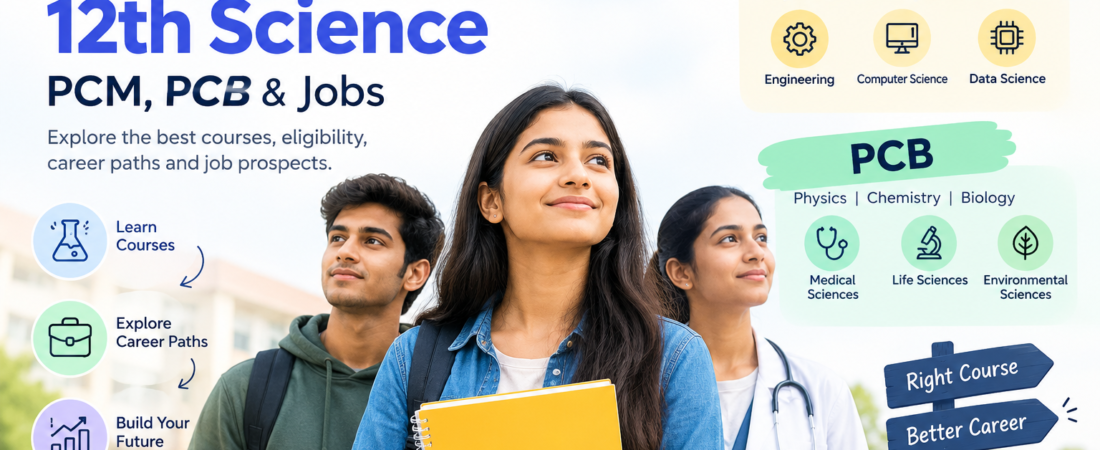
Choosing career options after 12th Science can feel confusing because you have many options beyond engineering and medicine. You can explore technology, healthcare, life sciences, business, design, research and several other fields. The right choice depends on your subjects, interests, eligibility, budget and the kind of work you want to do.
This guide explains popular courses after 12th Science, compares PCM and PCB career options, and shows you how to shortlist courses before applying. Use it as a starting point, then verify the latest admission requirements with the relevant college or official admission authority.
In this guide
- Quick answer
- Courses and careers for PCM students
- Courses and careers for PCB students
- Options for PCMB students
- Other courses after 12th Science
- Course comparison table
- How to choose the right course
- Salary and job prospects
- Frequently asked questions
Quick answer: Which courses can you do after 12th Science?
Your Class 12 subjects influence which courses you can apply for, but they do not define your entire career.
- If you studied PCM (Physics, Chemistry and Mathematics): explore engineering, computer science, architecture, statistics, data-related degrees, physics and other technology or science programmes.
- If you studied PCB (Physics, Chemistry and Biology): explore medicine, dentistry, pharmacy, nursing, physiotherapy, biotechnology, microbiology, life sciences and other healthcare or biology-related programmes.
- If you studied PCMB: you may be eligible for options in both groups, subject to each course’s requirements and entrance exams.
- If you want a path beyond traditional science careers: some students can also consider management, design, law, hospitality, media or other degrees, depending on the institution’s eligibility rules.
Before choosing, check the required subjects, minimum marks, entrance exam, total course cost and whether further study or professional registration is needed.
1. Best Career Options After 12th Science PCM
PCM is a common combination for students interested in mathematics, engineering, computing, physical sciences and technical problem-solving. These are some options to research.
Engineering (BE/BTech)
Engineering programmes combine scientific principles with practical problem-solving. Specialisations may include computer science, information technology, electronics, electrical, mechanical, civil, chemical and other engineering branches.
- Typical duration: 4 years for a bachelor’s degree.
- Suitable for: students who enjoy mathematics, systems, design, building or solving technical problems.
- Possible careers: software engineer, electronics engineer, civil engineer, mechanical engineer or other roles related to the chosen branch.
- Check before applying: required subjects and marks, accepted entrance exams, accreditation, laboratory facilities, internships and the full fee structure.
Computer Science, IT and related degrees
Students interested in programming, software, data and digital systems can explore computer science or information technology degrees. Depending on the university, options may include BTech, BSc Computer Science, BCA or other computing programmes. Eligibility differs, especially regarding Mathematics.
- Typical duration: often 3 or 4 years, depending on the degree and institution.
- Possible careers: software developer, web developer, QA tester, IT support specialist or junior data-related roles, depending on skills and experience.
- Good preparation: try basic coding, build small projects and learn how to solve problems before committing to a programme.
Architecture (BArch)
Architecture combines design, spatial planning, technical knowledge and an understanding of buildings. It may suit students who enjoy mathematics as well as drawing, design and the built environment.
- Typical duration: 5 years for the BArch programme in India.
- Possible careers: architect after meeting the applicable registration requirements, architectural assistant or related design and planning roles.
- Check before applying: current eligibility, accepted aptitude or entrance tests, and the Council of Architecture’s requirements.
Statistics, Mathematics and Data-related degrees
Students who enjoy numbers, patterns and analytical reasoning can explore BSc Mathematics, Statistics, Data Science or related programmes. Course names and eligibility vary by university, and some programmes require Mathematics in Class 12.
- Typical duration: commonly 3 or 4 years, depending on the programme and institution.
- Possible careers: junior data analyst, statistical assistant or research support roles; some specialised roles require postgraduate study or additional skills.
- Useful skills: statistics, spreadsheets, programming and communicating findings clearly.
Pure Science degrees
BSc programmes in Physics, Chemistry, Mathematics and related subjects suit students who want to understand scientific concepts in depth. These courses can lead towards laboratories, research support, teaching after the required qualifications, industry roles or further study.
Check the course structure and progression options. A bachelor’s degree alone may not qualify you for every research, teaching or specialist position.
2. Best courses after 12th Science PCB
PCB is a common subject combination for students interested in living organisms, healthcare, medicine, laboratory science and public health. Some professional courses have specific entrance, registration or practical-training requirements.
MBBS (Medicine)
MBBS is the primary medical degree for students who want to pursue a career as a doctor in modern medicine in India. Admission is competitive and requires meeting the applicable eligibility and entrance requirements.
- Typical duration: about 5.5 years, including the compulsory internship, subject to current regulations.
- Possible career path: medical practice after completing the required internship and registration; further training may be needed for specialisation.
- Consider carefully: entrance preparation, length of training, total fees, clinical responsibilities and the demands of patient care.
BDS (Dentistry)
BDS prepares students for a professional career in dentistry. It involves studying oral health, dental conditions, diagnosis and treatment.
- Typical duration: generally 5 years, including the required internship.
- Possible career path: dental practice after fulfilling applicable registration requirements, or further study in a dental speciality.
- Check: current admission rules, recognised institutions, clinical training and total cost.
BPharm (Pharmacy)
Pharmacy focuses on medicines, their preparation, safe use, quality and effects. Depending on the role and qualifications, graduates may explore pharmaceutical companies, quality-related work, regulatory functions or pharmacy practice.
- Typical duration: 4 years for BPharm.
- Possible careers: roles in pharmaceutical production, quality control, regulatory support or pharmacy, subject to the applicable requirements.
- Check: the institution’s recognition, eligibility rules and registration requirements for the role you want.
BSc Nursing
Nursing education prepares students to provide patient care and work as part of healthcare teams. It combines classroom learning with supervised clinical experience.
- Typical duration: generally 4 years for BSc Nursing.
- Possible careers: nursing roles after meeting applicable registration requirements, with opportunities to specialise through further training and experience.
- Consider carefully: clinical placements, shift work, communication skills and the emotional and physical demands of patient care.
BPT (Physiotherapy)
Physiotherapy focuses on movement, physical function, rehabilitation and helping people manage or recover from injury and certain health conditions. Programme structures and internship requirements should be checked with the institution and relevant authority.
- Typical duration: commonly around 4 to 4.5 years, depending on the programme and internship structure.
- Possible careers: physiotherapy and rehabilitation roles after meeting applicable professional requirements.
- Suitable for: students interested in anatomy, movement, rehabilitation and working directly with people.
Biotechnology, Microbiology and Life Sciences
These programmes explore living systems, cells, microorganisms, genetics and biological processes. They can suit students who enjoy Biology and laboratory or research work.
- Typical duration: often 3 or 4 years for a bachelor’s programme, depending on the institution.
- Possible careers: laboratory assistant, research support or entry-level industry roles, depending on the course and employer requirements.
- Important: some research and specialised roles require postgraduate study, practical experience or additional qualifications.
Other healthcare and biology-related options
You can also research programmes such as medical laboratory technology, radiology or medical imaging, optometry, nutrition and dietetics, public health-related degrees and other allied-health programmes. Their names, duration, eligibility and professional requirements vary. Verify recognition and current rules before paying admission fees.
3. What if you studied PCMB?
Students who studied Physics, Chemistry, Mathematics and Biology may be able to consider options from both PCM and PCB groups. However, studying all four subjects does not automatically guarantee eligibility for every programme.
Make a shortlist based on the entrance exams you are willing to take, the subjects you enjoy most, the length and cost of training, and the type of work you want to do. Compare a few realistic options rather than trying to prepare for every possible pathway at once.
4. Other courses after 12th Science
Your Science background does not mean you must choose engineering, medicine or a laboratory career. Depending on the programme and institution, you may also be eligible for options such as:
- Business and management: BBA and other management-related bachelor’s programmes.
- Commerce and economics: selected BCom, economics, finance or related degrees, subject to specific subject requirements.
- Design: communication, product, interior, fashion or other design programmes with their own portfolio or entrance requirements.
- Law: integrated law programmes where you meet the institution’s eligibility and entrance requirements.
- Hospitality and tourism: programmes in hospitality, hotel management and tourism.
- Media and communication: journalism, media studies, animation or related creative programmes.
These are possibilities to investigate, not a guarantee that every institution will accept every Science student. Always check the current eligibility criteria.
5. Course comparison: duration, interests and possible careers
Use this table to shortlist options. Durations are typical examples and may vary with the institution, course structure, internship or current regulations.
| Course or field | Common subject fit | Typical duration | Possible direction |
|---|---|---|---|
| BE/BTech | PCM | 4 years | Engineering and technology |
| BSc Computer Science / related computing degrees | Often PCM; rules vary | 3–4 years | Software, IT and further study |
| BArch | PCM, subject to current rules | 5 years | Architecture and built environment |
| BSc Mathematics / Statistics | Usually Mathematics required | 3–4 years | Analytics, statistics and research pathways |
| MBBS | PCB, subject to entrance and eligibility rules | About 5.5 years including internship | Medical practice after required registration |
| BDS | PCB, subject to entrance and eligibility rules | About 5 years including internship | Dentistry after required registration |
| BPharm | Usually PCM or PCB, subject to rules | 4 years | Pharmaceutical and pharmacy-related roles |
| BSc Nursing | Usually PCB, subject to rules | About 4 years | Nursing after required registration |
| BPT | Usually PCB, subject to rules | Varies; often around 4–4.5 years | Physiotherapy and rehabilitation |
| BSc Biotechnology / Microbiology | Usually Biology or related science subjects | 3–4 years | Life sciences, laboratories and further study |
| BBA | May accept students from different streams | Usually 3–4 years | Business and management pathways |
Important: this is a broad comparison, not an official eligibility list. Verify current course duration, entrance exams, subject requirements, fees and professional recognition before applying.
6. How to choose the right course after 12th Science
Before choosing a course, answer these questions honestly.
1. Which subjects do you actually enjoy?
Think about the topics you enjoy learning and the kind of problems you like solving. Enjoying Biology does not automatically mean you must become a doctor, just as enjoying Mathematics does not mean engineering is your only option.
2. What kind of work do you want to do?
Do you prefer working with people, computers, machines, data, experiments, designs or business problems? Look at the day-to-day tasks of the career, not just the course name or its reputation.
3. What are the eligibility and entrance requirements?
Check required Class 12 subjects, minimum marks, entrance exams, application dates and any additional admission conditions. Use official exam or institution websites for the latest information.
4. What is the full cost?
Include tuition, examination fees, travel or hostel costs, books, equipment and other expenses. Compare the complete cost of the programme, not just the first year’s tuition.
5. What happens after graduation?
Research typical entry-level roles, required skills, further-study options and the availability of jobs in your intended location. Ask whether a bachelor’s degree is sufficient or whether licensing, postgraduate study or supervised training is needed.
6. Can you try the field before committing?
Explore introductory lessons, free coding exercises, science activities, conversations with professionals or open days. A small practical trial can help you discover whether the subject interests you beyond its reputation.
7. Is the institution recognised for the course?
Verify the relevant university affiliation, programme approval, accreditation or professional recognition where applicable. Do not rely only on advertisements or placement claims.
8. Do you have a backup option?
Shortlist two or three suitable pathways. Consider entrance-exam uncertainty, affordability and alternative routes that still match your interests.
7. Salary and job prospects after 12th Science
There is no single salary for a course. Earnings depend on the job role, location, employer, skills, experience, further qualifications and the overall job market. A high advertised package is not a reliable prediction of what every graduate will earn.
Before choosing a course, look for recent and credible information about entry-level roles. Review job descriptions, required skills, internship opportunities and official placement reports where available. When reading placement reports, check how many students were eligible, how many were placed, and whether the figures represent median or highest salary.
Choose a course for its fit with your abilities, interests, budget and realistic career pathways—not on the promise of a particular salary.
Frequently asked questions
Which course is best after 12th Science?
There is no single best course for everyone. PCM students may explore engineering, computing, mathematics and physical sciences; PCB students may explore healthcare and life sciences. Compare eligibility, cost, interests and career requirements before deciding.
What are the best courses after 12th Science without NEET?
Depending on your subjects and the institution’s requirements, options may include engineering, computer science, architecture, pharmacy, biotechnology, microbiology, nursing, physiotherapy and other degrees. Some courses have their own entrance exams or additional eligibility rules, so verify them individually.
What can I do after 12th Science PCB besides MBBS?
You can research BDS, pharmacy, nursing, physiotherapy, biotechnology, microbiology, life sciences and allied-health programmes. Each has different training, eligibility and career requirements.
Which courses are available after 12th Science PCM?
Options include engineering, computer science and IT-related degrees, architecture, Mathematics, Statistics, Physics, Chemistry and certain data-related programmes. Check subject and entrance requirements for each course.
Can a Science student choose commerce or management?
Yes, many institutions accept students from different streams for selected business, management or commerce-related programmes. However, eligibility differs by institution and degree, so check the official admission criteria.
Are short-term courses better than degrees?
Not necessarily. Short-term courses can help develop specific skills, while degrees may be required for certain professions or further study. Compare recognition, cost, course content, employer expectations and progression options before deciding.
How can I check whether a college is genuine?
Verify its affiliation and the relevant course approval or professional recognition through official sources. Review the full fee structure, refund rules, faculty, facilities and written placement information. Be cautious about pressure to pay immediately or promises of guaranteed jobs.
Final thoughts
There are many courses after 12th Science, and the right choice is the one that fits your interests, eligibility, finances and longer-term plans. Start by comparing a few realistic options, verify the official admission requirements and learn what the work involves before committing.
You do not need to decide your entire future in one day. A careful shortlist and reliable information can help you make a more confident decision.
Before applying: confirm the latest eligibility, admission dates, course duration, fees and recognition requirements directly with the relevant official authority or institution.